Semantic Sovereignty: Who Controls the Knowledge AI Runs On?
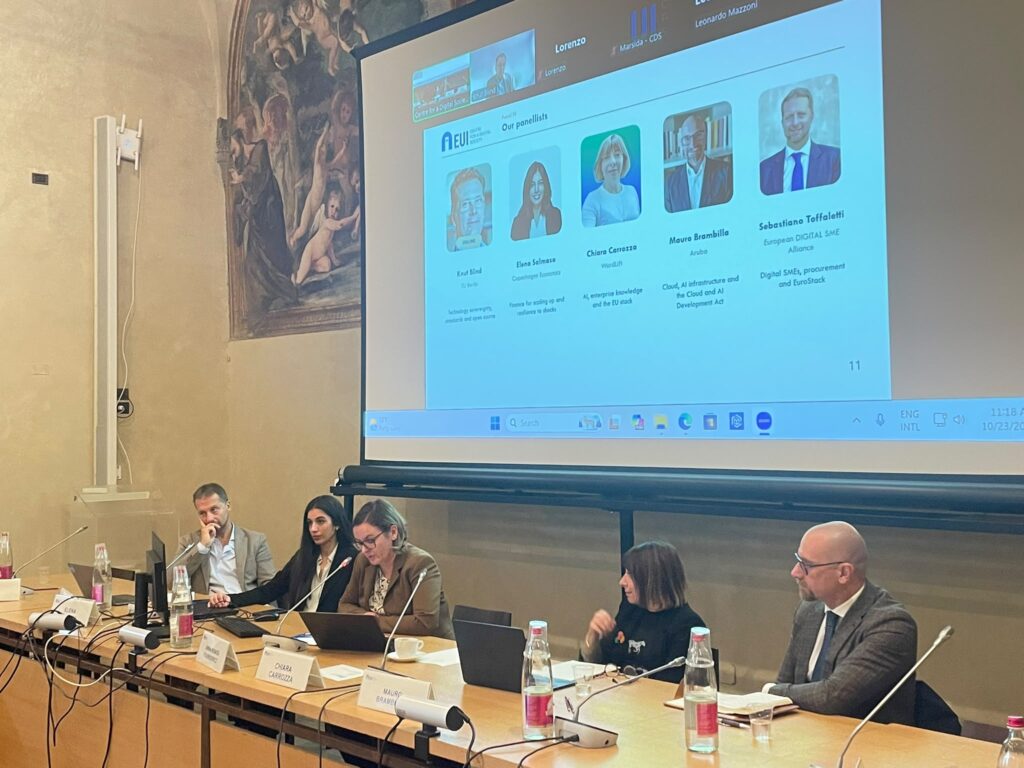
At the European University Institute’s conference, Chiara Carrozza explored a question that is becoming central to enterprise AI: who controls the organisational knowledge that AI models and platforms use to understand, reason and act?
As AI moves from applications to agents, enterprise knowledge is becoming a strategic layer of the technology stack. This raises a new question for companies — and for Europe.
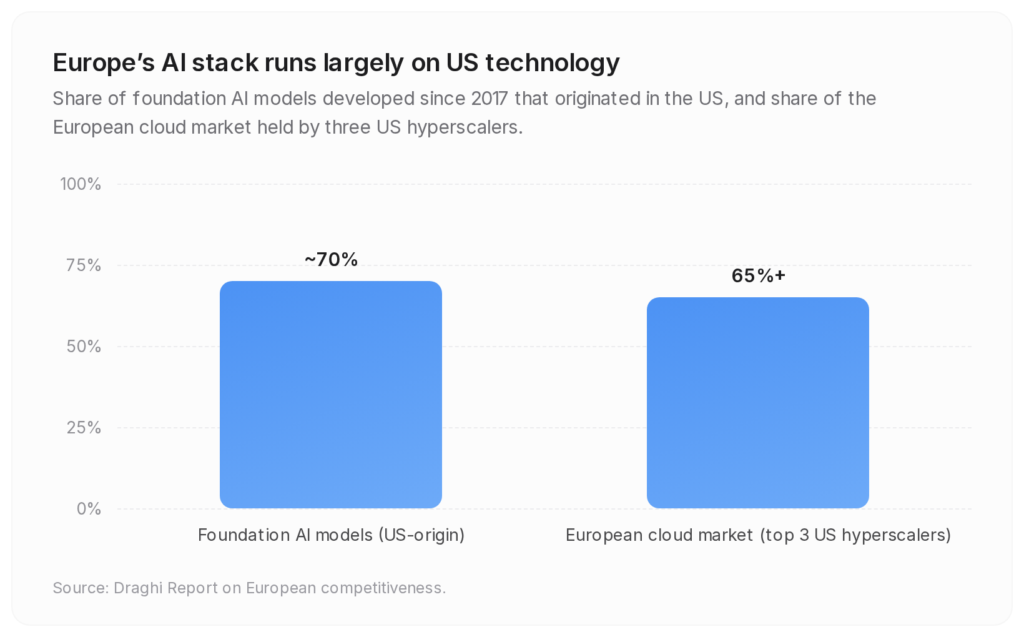
Technological sovereignty has become a central concept in the European debate on AI. The discussion spans semiconductors and compute, cloud infrastructure, foundation models, data, software and open source — reflecting a broader concern about Europe’s ability to control critical technologies while remaining part of global technology ecosystems. The Draghi Report captures the scale of Europe’s technological dependency: around 70% of foundational AI models developed since 2017 originated in the US, while three US hyperscalers control more than 65% of the European cloud market. The latest European Commission’s technological sovereignty agenda itself takes this broad, value-chain perspective.
At WordLift, however, our work has led us to look at sovereignty from a more specific angle.
Speaking at the European University Institute’s conference Europe’s momentum to scale? Startups, innovation and the future of European competitiveness, in a panel exploring the contribution of startups and scaleups to European strategic autonomy, I shared some observations from our work with large enterprises on semantic and knowledge infrastructure.
They point to what I believe is becoming an important question for enterprise AI:
Who controls the organisational knowledge that AI models and platforms use to understand, reason and act?
The layer between enterprise data and AI
WordLift has been working with knowledge graphs and semantic technologies for many years. A useful way to understand this work is to locate it within the enterprise AI stack.
At the bottom, organisations have their data: documents, databases, product catalogues, policies, customer information and operational systems. At the top, increasingly, they have AI applications and agents.
Slide layers
Between these two sits a less visible but increasingly important layer: the semantic layer.
Its role is to give enterprise information context and structure.
This matters because AI is now interacting with organisations from two directions.
Outside the enterprise, search engines, answer engines and AI agents increasingly mediate how people — and other agents — discover companies, products and information.
Inside the enterprise, agents are starting to support decisions, perform tasks and interact with internal workflows.
In both cases, access to information is not enough. AI systems need to understand the organisation they are interacting with.
From AI pilots to the operational reality of the enterprise
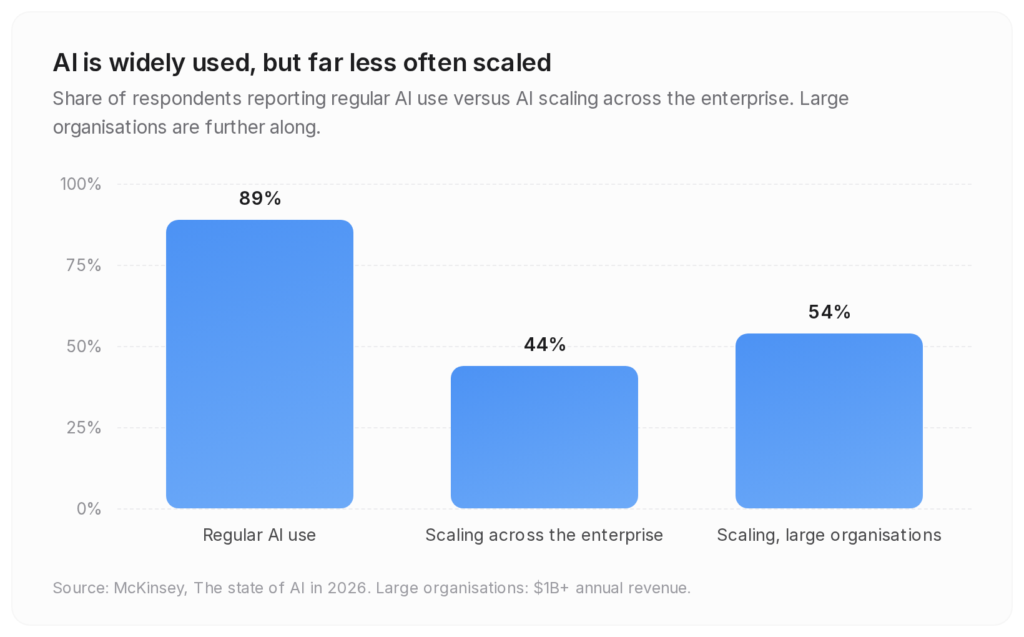
Over the past few years, enterprises have experimented extensively with generative AI and, increasingly, with agents. Moving from successful experiments to enterprise-scale deployment has proved more complex. McKinsey’s 2026 global survey found that nearly nine in ten respondents report regular AI use in at least one business function, while 44% say AI is scaling across the enterprise. Among large organisations, the figure rises to 54%.
One reason is relatively straightforward: a pilot can work very well in isolation and still struggle when it meets the operational reality of a large organisation.
Enterprise information is spread across systems, business units and stakeholders. The same term may have different meanings in different parts of the organisation. There are questions of ownership and authority, complex workflows, compliance requirements and constraints on what information can be used, by whom and for what purpose.
AI models do not inherently know any of this.
They are powerful probabilistic systems, but the meaning an organisation has developed and negotiated over years of work is not automatically available to them.
A semantic layer is one way of making this context explicit. It can describe the entities that matter to an organisation and the relationships between them, but also provenance, ownership, business rules, constraints, definitions and governance.
In other words, it can turn scattered information and organisational knowledge into a formal representation of the enterprise that AI systems can use as context — and, where appropriate, as a guardrail.
From data sovereignty to semantic sovereignty
This is where sovereignty becomes tangible.
Imagine an organisation connecting thousands of documents, databases, product records, policies and workflows directly to an AI platform.
The organisation may continue to own all of its original data. But as the system develops, another set of assets begins to accumulate around that data: how information is retrieved and indexed, which sources are considered authoritative, how context is assembled, how agents are configured, which relationships have been modelled, which workflows have been encoded and which patterns have been refined through use.
Those assets can become closely coupled to the platform in which they were created.
This suggests an extension of the familiar concept of data sovereignty.
Data sovereignty asks: Where is my data? Who stores it? Who can access it?
Semantic sovereignty adds another set of questions: Who determines what that data means? Where is organisational context represented? Who controls the relationships, rules and definitions through which AI interprets the enterprise? And can that representation move from one AI environment to another?
This distinction may become more important as the AI market evolves.
Models will change. Platforms will change. And with agentic AI, the application interface itself may become less central as agents increasingly operate across different software environments.
The enterprise should not have to reconstruct its knowledge every time one of those components changes.
Portability is where sovereignty meets competition
This leads to another concept: knowledge portability.
If an organisation can move its knowledge and context across models and platforms, it can continue to choose between providers. Models and platforms then have to compete on performance, price, quality and innovation.
If, instead, the knowledge architecture becomes deeply embedded in a single ecosystem, the cost of switching is no longer simply the technical cost of migrating data.
It may involve reconstructing part of the organisational intelligence that has accumulated around the system.
From this perspective, an open semantic layer can serve two purposes at once. It can help organisations retain control over a strategic asset, and it can reduce the risk of technological lock-in.
MOSAIC: building around sovereign enterprise knowledge
This is also the direction of our current R&D work at WordLift.
Starting from our long experience in graph technologies, MOSAIC brings together work on knowledge graphs, ontologies, agentic systems and governance around an infrastructure for sovereign enterprise knowledge: a knowledge layer controlled by the organisation that different models, agents and applications can use.
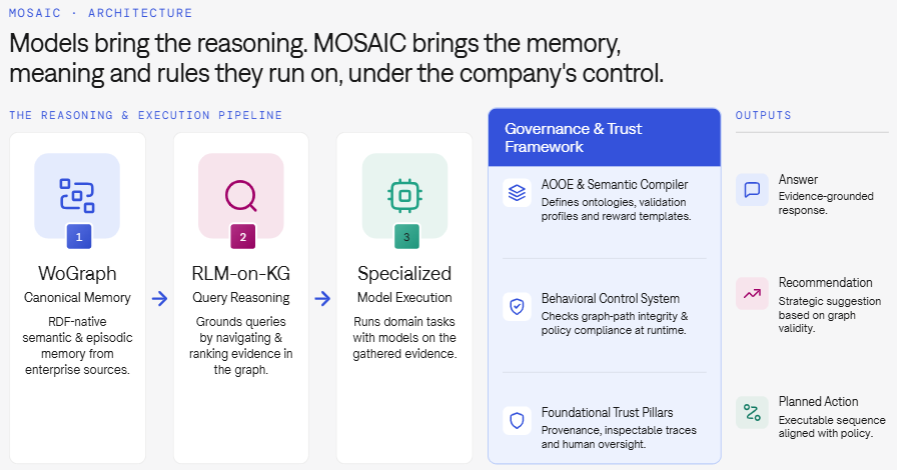
The technical architecture is less important here than the principle behind it: models and applications can change; the enterprise’s strategic knowledge should remain portable and under its control.
What does this mean for Europe?
This perspective also suggests a slightly different way of approaching technological sovereignty at European level.
The question cannot simply be whether Europe can reproduce a domestic alternative to every American or Chinese model, cloud platform or application.
Some parts of the technology stack will clearly require stronger European capacity. In other parts, access to globally competitive technology may be both desirable and economically rational.
The more strategic question is:
At which layers does dependency become a problem — and at which layers can Europe realistically intervene to preserve choice and control?
This means looking at the AI stack not as a single sovereignty problem, but as a series of dependencies with different characteristics.
At one layer, the issue may be access to physical compute capacity. At another, concentration among cloud providers. Elsewhere, it may be control over models, software interfaces or standards.
At the enterprise level, the semantic and knowledge layer deserves to be part of this analysis because it can determine how easily an organisation can move between all of those other layers.
The relevant policy questions then become more specific.
How expensive is it to switch?
Which strategic assets have to be reconstructed when a provider changes?
Are interfaces genuinely interoperable?
Can enterprise knowledge be reused across competing models and agent frameworks?
Which dependencies can be reduced through open standards, open source and portable architectures rather than by creating a European substitute for every product?
This approach is broadly consistent with an emerging shift in EU policy. Europe’s technological sovereignty agenda already combines investment in domestic capacity with open source, interoperability, competitive markets and reduced lock-in rather than treating technological autonomy as isolation.
It also helps clarify where public intervention may have the greatest leverage. Instead of spreading resources uniformly across the entire stack, Europe can focus investment, standards, procurement and competition policy on the layers where dependency is both strategically significant and realistically contestable.
That matters for financing too. Infrastructure and enabling technologies can require longer development cycles than applications and may not always fit the return horizons of private capital. Public investment can therefore play a complementary role where the strategic value of maintaining an open and competitive layer appears earlier than its commercial return.
Sovereignty without isolation
Technological sovereignty does not have to mean technological self-sufficiency.
For European enterprises, a more useful objective may be the ability to use the best technologies available globally without surrendering control over the assets that make those technologies valuable in the first place.
Enterprise knowledge is one of those assets.
As AI moves deeper into organisational processes, the question of who controls the context, rules and meaning on which AI systems operate will become increasingly important.
Europe does not need to own every layer of the AI stack.
But it does need to understand which layers it cannot afford to lose control over — and where openness, portability and competition can prevent dependency from becoming lock-in.