One Playbook, Four Brands: L’Oréal Türkiye CPD’s Up to 450% AI Search Growth
Four brands, one playbook. WordLift built a knowledge graph architecture for L'Oréal Paris, Garnier, Maybelline New York, and NYX Professional Makeup in Türkiye, turning product pages into the source AI search cites.

The market is answering questions before a brand’s website ever loads
AI Overviews now appear on roughly one in five Google searches. When they do, click-through rates to the open web fall by close to 60%, according to a 2026 SparkToro analysis. But brands cited inside those AI answers are rewarded for it. Seer Interactive’s November 2025 study of informational queries found that cited brands earn 35% more organic clicks than brands the same AI ignores.
The pattern is simple. Consumers increasingly meet a beauty brand inside an AI-generated answer before they ever meet its website. Whoever supplies the data behind that answer shapes the decision.
L’Oréal Türkiye’s Consumer Products Division ran into that shift across four brands at once: L’Oréal Paris, Garnier, Maybelline New York, and NYX Professional Makeup.
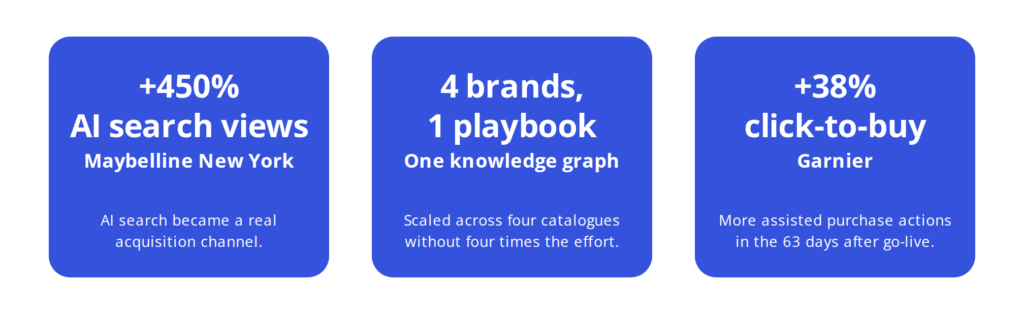
“Working with WordLift across four of our brands showed us that AI-driven search is no longer an emerging trend, it’s an active acquisition channel. By structuring our product data into a single knowledge graph, we made our content something AI systems could actually understand and cite, not just index. Seeing Maybelline New York’s AI search views grow by 450% confirmed that owning your product information at the source directly translates into real, measurable business impact.”
Berrak Deniz – Online Activation Specialist at L’Oréal
The challenge: brand sites that inform the decision but never close it
None of the four sites sell directly. Purchase happens at retailers and marketplaces. So each site’s job is to shape the decision, then send people onward through virtual try-ons, seller finders, and category pages.
That makes each site the brand’s product-truth layer for the whole search ecosystem. Ingredients, benefits, usage, claims, and Turkish-language product naming are stated there first, by the brand. When a brand’s own version of a product isn’t machine-readable (meaning a computer program, not just a person, can read and understand it), the ecosystem fills the gap with third-party interpretations the brand doesn’t control.
Working across four brands surfaced the same five gaps:
- Machine-readability was incomplete. Product pages carried a name, price, image, and brand. That is enough to index, but not enough to answer a question.
- Localization did not match demand. Turkish product and category pages were thin compared to real search volume. Category pages worked as navigation, not as answers.
- Narrative control was slipping. Without structured, brand-owned product data, third parties became the default source of product information in AI results.
- There was no feedback loop. AI search was already sending traffic, but it wasn’t isolated or attributed. Nothing could be steered by it.
- Four brands meant four catalogues. All of it had to scale without four times the operational load.
Being findable was not the same as being citable. And being citable was not the same as controlling what got cited.
The solution: one playbook, run across four brands
WordLift built and ran five workstreams as a single playbook across all four brands.
A knowledge graph turns product truth into infrastructure machines can understand. It connects products, categories, ingredients, benefits, claims, content, and digital services into one model. It also names the brand as the authoritative source behind all of it.
Without a graph, search engines and AI systems have to guess at meaning from isolated pages. With one, each thing is clearly defined: what it is, how it relates to everything else, and where the information comes from. That is what makes a brand’s content easier to understand, retrieve, and cite consistently.
- Knowledge graph creation and structured data automation. A connected entity graph for each brand, published in the schema.org format search engines and AI systems read (JSON-LD), maintained automatically instead of hand-coded page by page. One organization node anchors each graph: every product, article, category page, and interactive tool connects back to a single brand entity, which links up to L’Oréal Groupe. That is what lets a machine reason about what the brand sells and who stands behind it.
- Product and category content localization. Native Turkish content built for classic search and AI answers at the same time. Thin product pages became complete. Category pages were rewritten to give real category context instead of just a product grid. Editorial guides were built around real consumer questions.
- Technical SEO and on-site optimization. Internal linking was aligned to the entity structure above, so link structure and meaning reinforce each other. This ran alongside a content freshness program and quality checks on the structured data.
- FAQ content generation. Search demand data from Google Search Console was combined with the product and listing page structure. Content gaps were mapped one entity at a time, and every answer was grounded in the knowledge graph. Much of this content already existed in visible page copy. Structuring it into a citable format took almost no new writing.
- AI traffic measurement, used to steer the work. AI and LLM referral traffic was isolated in first-party tools. Each brand was read against its own period before and after go-live, of equal length, and the results shaped where to focus next.
Three details show the level of care behind the delivery. Virtual try-ons and product finders were modeled as their own discoverable digital services, not as plain pages. Product identifiers (GTIN codes) were published so Google can match a product to its own catalogue instead of guessing. And on L’Oréal Paris, the FAQ markup was deliberately held back until the client’s own accordion design shipped, so the two would not compete. Data quality took priority over speed.
“This project proved that scaling AI search performance across multiple brands doesn’t require multiplying effort, it requires the right architecture. WordLift’s knowledge graph approach let us apply one consistent model across L’Oréal Paris, Garnier, Maybelline New York, and NYX Professional Makeup, each with its own catalogue and content needs. The results, from a 450% increase in AI search views to a 38% lift in click-to-buy activity on Garnier, show that structured, brand-owned data is now a core pillar of our digital performance strategy in Türkiye.”
Pınar Subaşı – Retail Media Manager at L’Oréal
The results: AI search became a real acquisition channel
Measurement basis: each brand’s period after implementation is compared to the period immediately before it, of equal length, using first-party data only (GA4, Google Search Console, Bing Webmaster Tools). Windows differ by brand.
| Brand | AI search views | Supporting metrics |
|---|---|---|
| Maybelline New York | +450% | +391% engaged sessions, +451% key events |
| NYX Professional Makeup | +391% | +429% active users, +423% sessions |
| Garnier | +138% (early read, shorter window) | +331% engaged sessions, +25% views per session |
Garnier’s figure comes from a much shorter window than the other two brands, so it is presented as an early read rather than ranked against them. Across the portfolio, active users, sessions, engaged sessions, and key events all moved together with the view counts. That is qualified traffic, not a spike in shallow referrals.
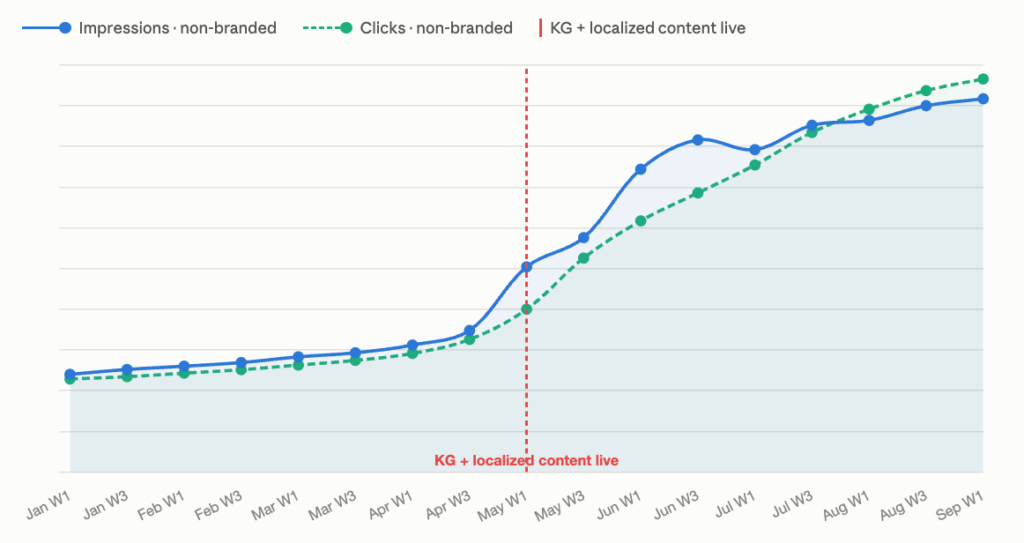
NYX Professional Makeup: non-branded discovery. Organic clicks grew 28.9%. Search impressions grew 11.4%. Most of that growth came from non-branded clicks. That means the site is now winning searches from people who haven’t picked a brand yet, the earliest stage of the decision.
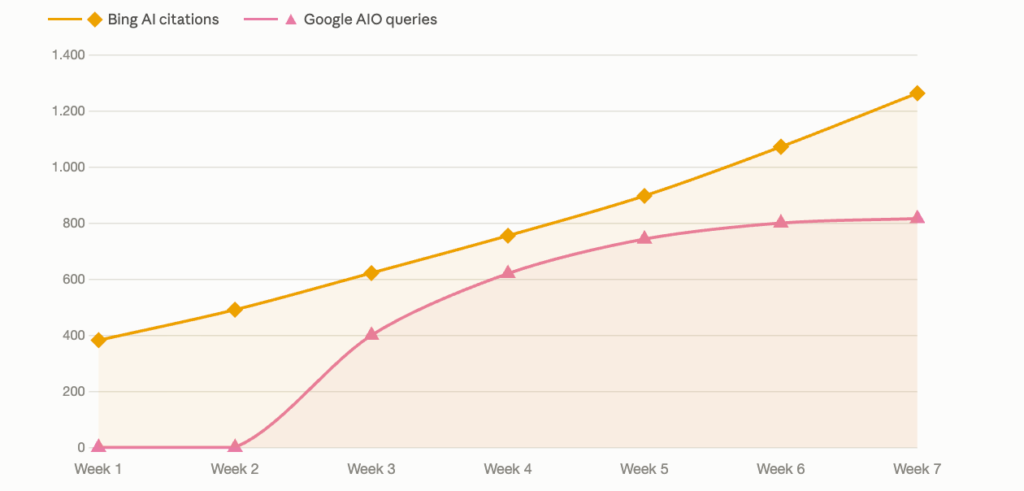
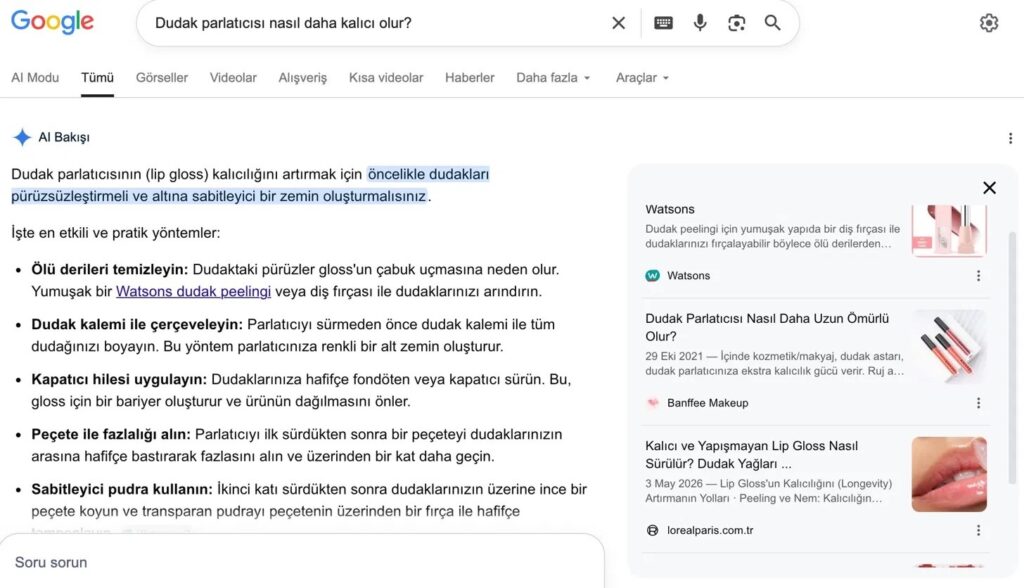
L’Oréal Paris: localization performance. A small set of localized Turkish articles drives roughly 15% of the site’s Google AI Overview impressions, and roughly 15% of its Bing AI citations. Both numbers are approximate, since one AI answer can pull from more than one page. The pattern is clear: simple, evergreen pages that answer plain questions (how something works, how to choose) punch well above their weight.
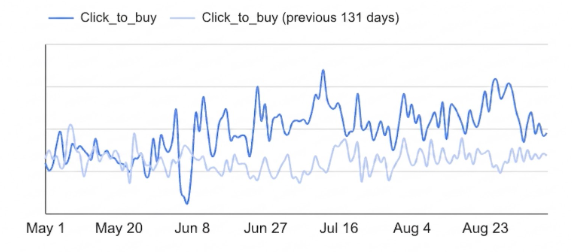
Garnier: quality traffic and assisted action. Click-to-buy activity ran roughly 38% higher on average in the 63 days after the knowledge graph went live, compared to the 63 days before.
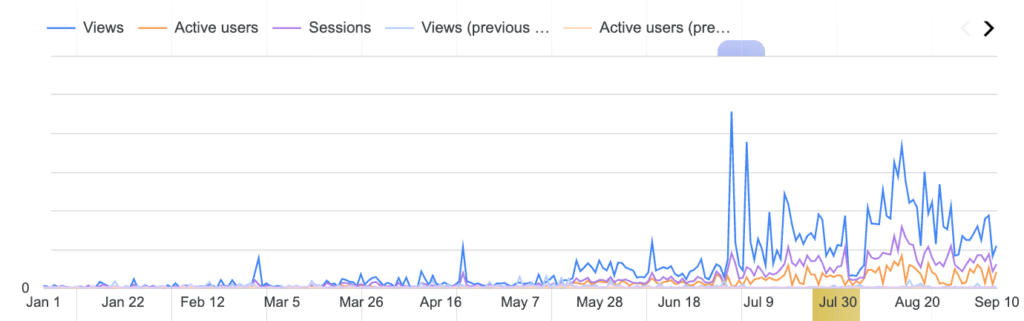
Maybelline New York: becoming the cited answer. AI systems chose to cite 24.3% more of the brand’s pages. Alongside that: organic clicks +9.7%, non-branded impressions +6.1%, editorial content clicks +18.3%, and the portfolio’s top figure, AI search views +450%. The 24.3% is the key number: it shows that turning content into machine-readable answers is what gets a page quoted.
Built to scale
One architecture now runs across four brands, each with a different catalogue and content shape, using the same entity model, the same automation, the same measurement frame. The graph is maintained automatically instead of page by page, so coverage grows without a matching rise in operational work.
The model is not specific to Türkiye. The same three-part approach, graph, localization, and structured product data, is designed to work in any market with local content and local search demand.
Why it matters
AI-driven discovery is a channel now, and the brands being cited inside it are the ones that own their product data at the source. For a brand site that doesn’t sell directly, that is the whole value: shaping the decision, and being the authority the ecosystem quotes.
Next steps for the CPD portfolio: deeper product enrichment, extending FAQ structuring to category pages, and structured product-feed work with conversational detail.
If your brand sites sit outside the purchase moment but shape the decision leading up to it, the same two questions apply. Is your product data structured well enough for a machine to cite it? And do you know which of your pages AI search is already choosing to quote?