The Full Stack of the Agentic Web: Why WebMCP is the New Schema.org Moment
Until now, agents have relied on brittle techniques like visual scraping to guess at actions. This breaks easily and doesn't scale. This is why the standardized Web Model Context Protocol (WebMCP) is critical.

At WordLift, we have spent over a decade championing the idea that for machines to understand the web, we must speak their language. We built the foundation using Schema.org, transforming unstructured content into rich Knowledge Graphs. We taught the web “nouns”, telling search engines this is a product, that is an event.
But in the era of generative AI, knowing what something is isn’t enough. The web is shifting rapidly from a library for humans to an operating environment for agents.
This is the dawn of the “Reasoning Web.” AI agents, whether in browsers or assistants, don’t just want to read about a flight; they need to book it. They don’t just want to see a product price; they need to add it to a cart.
Until now, agents have relied on brittle techniques like visual scraping to guess at actions. This breaks easily and doesn’t scale. This is why the standardized Web Model Context Protocol (WebMCP) is critical.
If Schema.org provided the standardized nouns of the web, WebMCP provides the standardized verbs. It allows websites to expose clear, executable actions directly to the browser’s AI.
What immediately interested me of WebMCP, however, isn’t just technical; it’s political.
History is repeating itself in a good way. In 2011, the search giants, Google, Microsoft, Yahoo, and Yandex, put aside competition to align on Schema.org. That unprecedented consensus built the structured open data web we rely on today.
We are witnessing that same vital alignment now with WebMCP. The fact that Google and Microsoft are throwing their weight behind this standard, incubating it through the neutral ground of the W3C, is the definitive signal that the Agentic Web will be open, interoperable, and built on shared infrastructure.
What does it mean for business?
For businesses, this is the wake-up call. It is no longer enough for your data to be structured; your business logic must be accessible. The friction between user intent and digital execution is about to collapse. The Agentic Web is open for business, and WebMCP is one of its components.
This shift requires a new infrastructure, a “Full Stack” for the Agentic Web. While WebMCP enhances the client-side (the browser), it is part of a broader ecosystem made of critical server-side standards that complete the picture: OpenAI’s ACP and Google’s UCP.
Here is how I see these pieces fitting together.
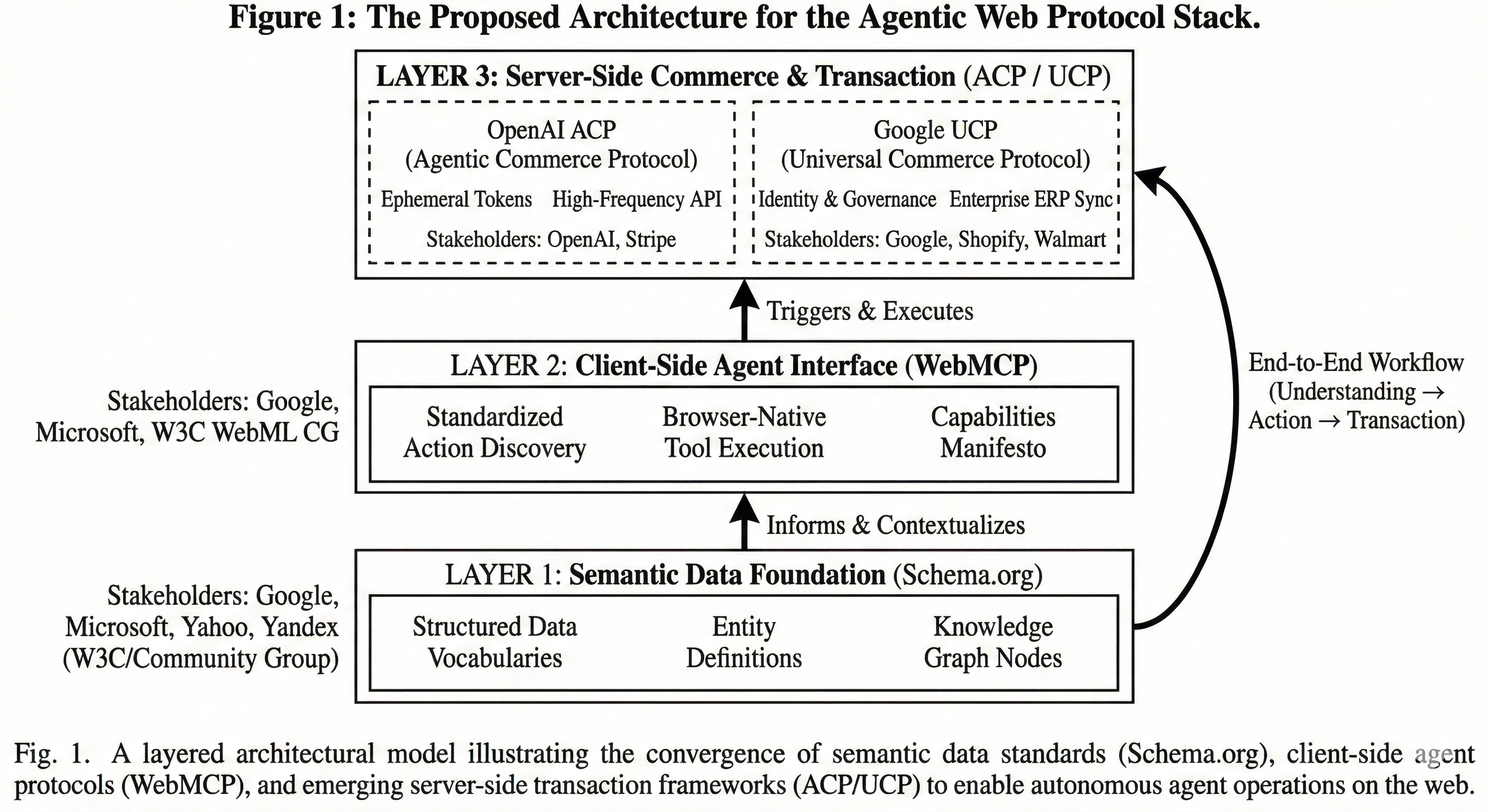
1. The Browser Layer: WebMCP (The “Hand”)
As I mentioned, WebMCP is our new Schema.org moment for actions. It resides in the browser, allowing an AI agent to “see” the tools available on a page, like addToCart or bookAppointment. It replaces the brittle practice of visual scraping with a standardized handshake.
But WebMCP is primarily a frontend technology. It is the digital hand that clicks the button. But what happens after the click? That is where the new commerce protocols come in.
2. The Transaction Layer: ACP and UCP (The “Wallet”)
To truly unlock the Reasoning Web, we need deep, secure, and transactional pipes that bypass the UI entirely. This month, we have seen two massive pillars rise to support this:
- OpenAI ACP (Agentic Commerce Protocol): Think of this as the “Fast Lane.” Developed with Stripe, ACP is designed for high-speed, conversational commerce. It uses ephemeral “Shared Payment Tokens” to let an agent complete a purchase inside a chat interface without ever exchanging raw credit card data. It is tactical, lightweight, and built for speed.
- Google UCP (Universal Commerce Protocol): If ACP is the fast lane, UCP is the “Heavy Haul Rail Network.” Launched just last month with partners like Shopify and Walmart, this is the governance layer. It handles complex, multi-step retail flows, identity verification, and deep inventory logic. It ensures that when an agent places an order, it syncs perfectly with enterprise ERPs.
The “Reasoning Web” is the architecture we are building today. At WordLift, we are already extending our Knowledge Graph to support these protocols, ensuring that your content isn’t just found by AI, it’s transacted by AI.
Are you ready to let Agents act on your website? Book a discovery call with our team!