Lot-Art Case Study: Securing AI Mode Visibility & 15% Lead Increase
This case study shows how Lot-Art improved AI search visibility and lead generation through a semantic SEO strategy tailored for art websites.

Executive Summary
Lot-Art.com, one of the leading search & analytics platforms to buy Fine Art & Collectibles at auction, partnered with WordLift to grow qualified traffic, increase memberships, and secure visibility in emerging AI-powered search experiences such as Google’s AI Mode.
Before working with WordLift, Lot-Art relied heavily on organic search and had already invested significantly in Google and Instagram ads. Despite the spend, paid channels delivered limited results in terms of qualified visitors and member growth.
By building a structured data foundation and making Lot-Art’s inventory easier for search engines and AI systems to understand, WordLift helped the platform achieve a strong increase in clicks (over +50%) and a solid uplift in leads (over +15%) in the first phase of the project. A second phase then focused on stabilizing performance and bringing lead growth back into positive territory, even as the broader market became more challenging.
Reaching Serious Investors, Not Just More Traffic
Before working with WordLift, we were spending a lot on Google and Instagram ads but attracting very little qualified traffic. We wanted a smarter way to reach serious art collectors and investors, not just more noise. WordLift helped us structure our content and inventory so that search engines and AI systems could really understand Lot-Art and our focus on providing up-to-date market analytics to collectors and art investors. Now we see our brand and our lots gaining visibility in AI Mode, and we are getting more qualified visitors who convert into members. We’re very satisfied with the quality of traffic and the impact this collaboration is having on our business.
Francesco Gibbi – CEO at Lot-Art
About Lot-Art
An art investment platform built on data and market transparency.
Lot-Art is an art investment platform based in Amsterdam that combines an advanced search engine, a marketplace, and analitical advisory services focused on fine art and “passion assets,” including luxury watches, design, classic cars, jewelry, and fine wines.
By aggregating auction catalogues from more than 4,800 auction houses, selected galleries, and private collectors worldwide, Lot-Art gives investors a real-time view of the global art market with the opportunity to spot best deals for investment.
The platform’s mission is to make art investment more effective and transparent. Using big data and market expertise, Lot-Art highlights highly liquid opportunities, including “Best Deals” lots offered below the average market value. Through memberships and advisory services, it helps clients use art and collectibles for portfolio diversification and long-term value preservation.
The Challenge
Why paid ads weren’t delivering qualified growth.
Lot-Art’s growth depends on attracting users with strong intent: investors and collectors actively searching for specific artists, categories, and price ranges. These users are far more likely to become paying members than casual browsers.
The team had tested paid advertising on Google and Instagram, but results were disappointing. Despite substantial investment, ads delivered limited improvements in qualified visits and conversions.
As a result, Lot-Art remained highly dependent on organic search to acquire new members. At the same time, the search landscape was changing rapidly. AI-generated answers and AI Mode were starting to dominate key queries, showing only a small number of trusted sources.
Lot-Art needed to:
- Increase qualified organic traffic to high-value pages, such as product detail pages and category pages.
- Improve lead generation and membership sign-ups from search.
- Secure durable visibility in AI search experiences, not just traditional blue links.
The Solution
Building an AI-ready search foundation.
WordLift supported Lot-Art with a semantic SEO and AI-search strategy built around two core pillars: structuring data so it can be understood by AI systems, and measuring results in a way that clearly links actions to business outcomes.
This was not about “doing more SEO,” but about creating a scalable data layer that could support growth today and in the future.
Structuring Lot-Art’s Data
Making inventory and content understandable to AI.
First, WordLift built a Knowledge Graph for Lot-Art and deployed it across up to 5,000 pages. This structured system clearly defines and connects key entities such as artists, artworks, auctions, prices, and categories.
Next, around 2,000 product detail pages were enriched with structured information for each lot. This included elements such as titles, images, sellers, brands, prices, and availability when present.
For Lot-Art, this meant that every item in the catalogue became easier for search engines and AI systems to recognize, interpret, and surface in relevant contexts. Instead of relying on keywords alone, the platform could now communicate meaning and relationships directly to AI-driven search experiences.
Measuring And Optimizing Performance
Proving impact, not just activity.
In parallel, WordLift created a business-friendly reporting dashboard that consolidated search and site performance data into a single view. This allowed the Lot-Art team to clearly compare how optimized pages performed versus the rest of the site.
Controlled tests were run by comparing pages enhanced with semantic data against standard pages. Over time, the optimized pages consistently outperformed the control group in terms of visibility, clicks, and leads.
WordLift also tracked traffic coming from AI assistants and AI search experiences. This showed a clear upward trend, confirming that Lot-Art’s content was increasingly being discovered and recommended by AI systems.
As a result, Lot-Art gained not only better performance, but also clear evidence linking structured data and semantic technologies to tangible business value.
The Results
More clicks, more leads, and greater stability.
The impact of the project was clear and measurable. In the first phase, pages enhanced with WordLift’s semantic and AI-focused approach achieved:
- Over +50% increase in clicks
- Over +15% increase in leads
An additional and particularly significant result came from AI search experiences. After WordLift implemented the Knowledge Graph and integrated the LLM.txt file in July 2025, more than 90% of all leads generated through AI engine conversations were recorded after this intervention.
This confirms that the structured data layer and AI-focused optimizations did not just improve traditional search performance — they directly contributed to growth from AI discovery channels.
In a second phase, the new setup helped stabilize performance in a more challenging market environment. While non-optimized pages saw a sharp drop in leads, the optimized pages maintained performance and returned lead growth to positive territory.
These results were validated through direct comparisons between optimized and non-optimized page groups over time, ensuring that the uplift was driven by the work done and not by general market fluctuations.
Visibility in AI Mode
Helping AI systems deliver better answers to users.
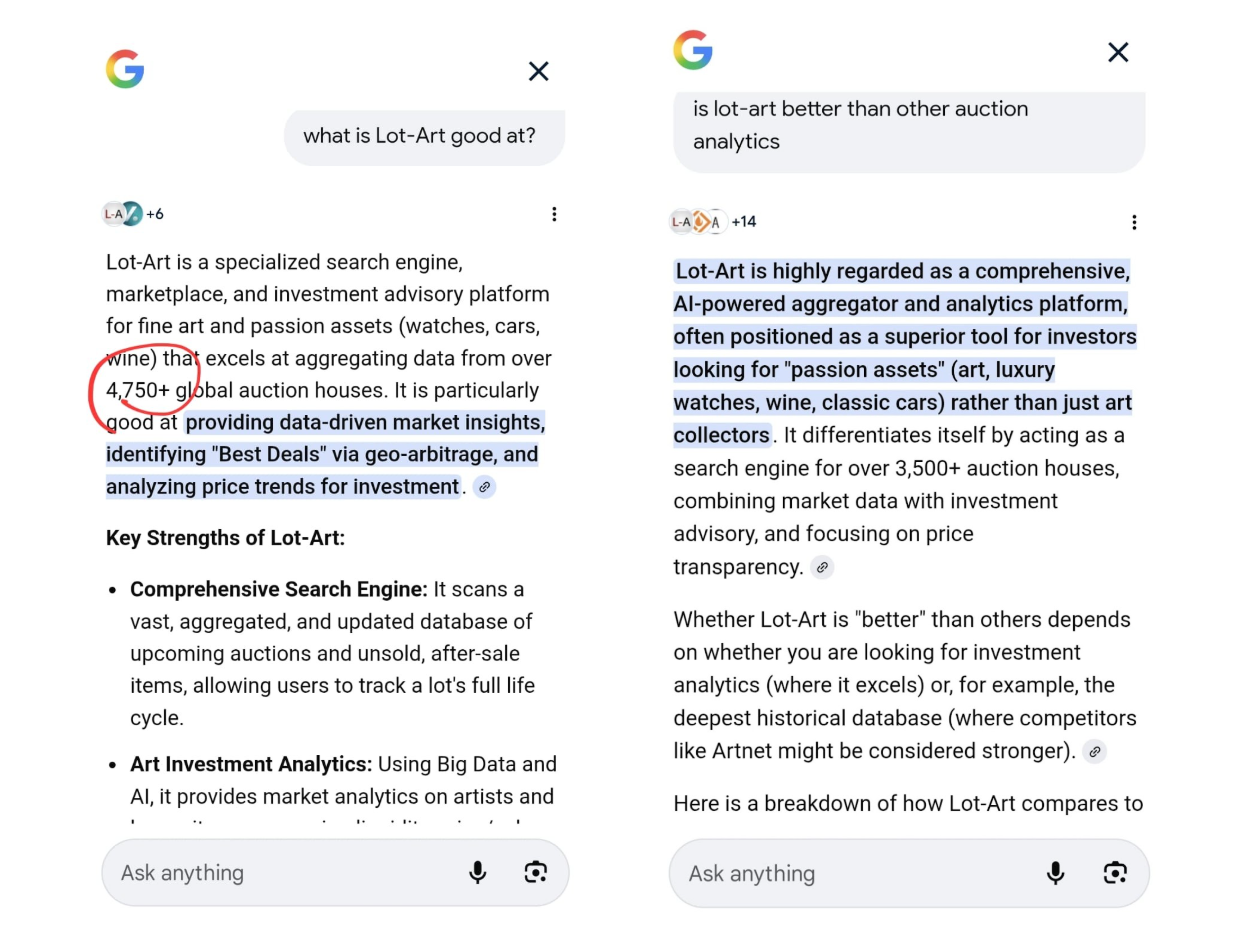
AI search experiences such as Google’s AI Mode are designed to give users clearer, more accurate, and more complete answers, especially for complex topics like investing in art and collectibles. Instead of simply listing links, these systems synthesize information from trusted sources to guide users more effectively.
By building a Knowledge Graph and structuring its content, Lot-Art made its data easier for AI systems to understand, connect, and validate. As a result, AI Mode can now use Lot-Art’s information to generate better answers for people searching for topics such as art investment strategies, auction opportunities, and specific categories of passion assets.
In practice, this means that Lot-Art is not just gaining visibility. Its data is actively contributing to higher-quality AI-generated responses, helping users make more informed decisions. Lot-Art appears as a cited and recommended source within AI Mode because its content is clearly structured, reliable, and aligned with how AI systems interpret meaning.
This represents a shift from “ranking for keywords” to powering the answers themselves, positioning Lot-Art as a trusted reference in AI-driven search experiences.
Conclusion
Turning AI visibility into qualified growth.
The collaboration between Lot-Art and WordLift demonstrates how investing in structured data and semantic technologies can drive real business outcomes. By building an AI-ready foundation and continuously measuring its impact, Lot-Art achieved more qualified traffic, stronger lead generation, and durable visibility in AI-powered search.
Rather than chasing short-term traffic spikes or increasing ad spend, Lot-Art positioned itself as a trusted reference for art investment—both in traditional search and in the new generation of AI-driven interfaces.
Is your website prepared for the new era of AI Search? Book a discovery call with our team today to find out how we can help you build your AI-ready foundation and drive qualified growth for your business.