The State of AI Search for E-Commerce
Discover how ready the world’s top e-commerce sites are for AI-powered product discovery and the gaps that could make or break them.


How the World’s Top 100 E-Commerce Sites Are Preparing for AI-Powered Discovery

Executive Summary
The e-commerce industry faces a critical AI visibility crisis. Our comprehensive audit of the world’s top 100 e-commerce websites reveals an average AI readiness score of just 64 out of 100—a stark indicator that even the largest online retailers are significantly underprepared for the shift toward AI-powered product discovery.
The data tells a sobering story: not a single site achieved a “Good” rating for image accessibility, automation readiness, or JavaScript rendering—three pillars essential for AI agent interactions. These are proven technical factors with documented, measurable impact on search visibility. With conversational commerce, AI shopping assistants, and LLM-powered search rapidly becoming mainstream, this gap represents both a challenge and an opportunity for sites that prioritize established optimization practices.
Methodology
Data Collection & Analysis Framework
This research analyzed 100 leading e-commerce websites homepages across 14 industry categories and 26 countries, representing the global landscape of online retail. Sites were selected based on traffic rankings, market capitalization, and regional significance to ensure comprehensive coverage of the e-commerce ecosystem.
Our AI Readiness Audit evaluates each site across seven core dimensions:
- Site Files — Presence and configuration of robots.txt and llms.txt files that govern AI crawler access and provide explicit instructions to large language models.
- SEO Fundamentals — Traditional search optimization factors including meta tags, title optimization, canonical implementation, and hreflang configuration for international sites.
- Structured Data — Implementation of schema.org markup, JSON-LD structured data, and semantic markup that enables AI systems to understand product information, pricing, availability, and relationships.
- Content Structure — Semantic HTML architecture, heading hierarchy, and document outline that allows AI agents to parse and comprehend page content programmatically.
- Image Accessibility — Alt text coverage, image descriptions, and visual content accessibility that enables AI systems to understand product imagery without relying solely on visual processing.
- Automation Readiness — Preparedness for AI agent interactions including form accessibility, action discoverability, and machine-readable interaction patterns.
- JavaScript Rendering — Assessment of content accessibility for non-JavaScript-executing crawlers and AI agents, evaluating whether critical content is available in the initial HTML response.
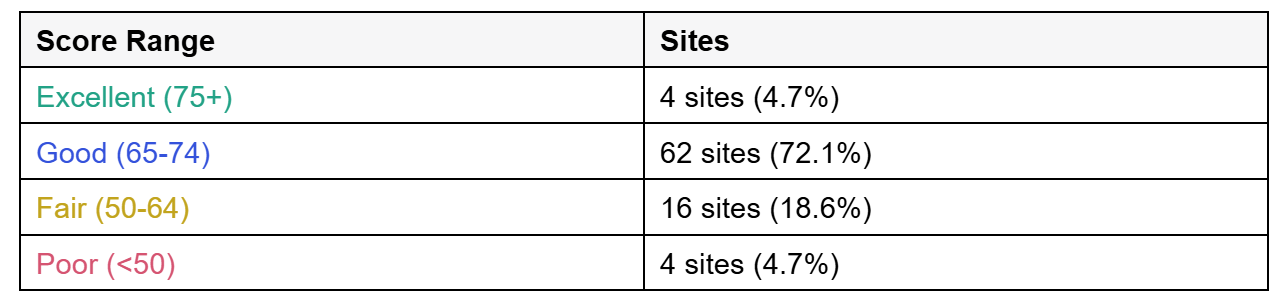
Each dimension is scored as “Good,” “Needs Improvement,” or “Poor,” with the overall AI Readiness Score calculated as a weighted composite ranging from 0 to 100. Sites scoring 75+ are considered “Excellent,” 65-74 “Good,” 50-64 “Fair,” and below 50 “Poor.”
Key Findings

1. The AI Readiness Crisis
The average AI readiness score of 64/100 masks a deeper problem: the distribution reveals that only 4.7% of sites (4 out of 86) achieve an “Excellent” rating of 75 or above. The vast majority cluster between 55-68, indicating systemic underinvestment in AI optimization across the industry.
Score Distribution:
2. Four Critical Gaps
Our analysis identified four metrics where the industry is failing almost universally. These are established technical factors with documented impact on search visibility:
Image Accessibility: 0% “Good”
Every single site analyzed has deficiencies in image accessibility for AI systems. This means product images—often the most critical element of e-commerce—cannot be effectively interpreted by AI shopping assistants and LLM-powered search engines. With 44.2% rated “Poor” and 55.8% rated “Needs Improvement,” this represents the industry’s most significant blind spot.
Automation Readiness: 0% “Good”
No site is fully prepared for the emerging wave of AI shopping agents. These autonomous systems need to browse, compare, add to cart, and complete purchases on behalf of users. With 87.2% of sites needing improvement and 12.8% rated poor, e-commerce platforms are not ready for agentic commerce.
JavaScript Rendering: 0% “Good”
The heavy reliance on client-side JavaScript frameworks has created a fundamental accessibility problem for AI crawlers. With 54.7% needing improvement and 45.3% rated poor, critical product information remains invisible to AI systems that don’t execute JavaScript—which includes most current LLM crawlers.
Content Structure: 3.5% “Good”
Only 3 out of 86 sites have properly structured semantic HTML that AI systems can easily parse. The remaining 96.5% use document structures that hinder machine comprehension, with 91.9% needing improvement and 4.7% rated poor.
3. Structured Data: A Mixed Picture
Structured data implementation shows the most variation across the dataset:
- Good: 38.4% (33 sites)
- Needs Improvement: 24.4% (21 sites)
- Poor: 37.2% (32 sites)
This near-even three-way split indicates that while some e-commerce leaders have invested in schema markup, the majority have either incomplete implementations or lack structured data entirely. Given that structured data is foundational for AI systems to understand products, prices, and availability, this inconsistency creates an uneven playing field.
4. A Note on llms.txt (Emerging, Unproven)
The llms.txt file is a proposed standard introduced by Jeremy Howard of Answer.AI in September 2024. It allows websites to provide guidance to AI systems about content priorities—similar to robots.txt for traditional crawlers. In our sample, 9.3% of sites (8 out of 86) have implemented this file.
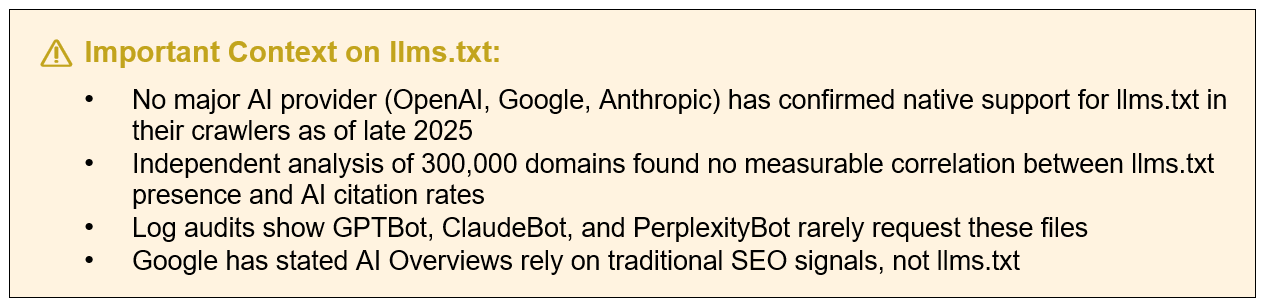
Unlike the proven factors discussed above (image accessibility, JS rendering, structured data, content structure), llms.txt remains a grassroots experiment with theoretical—not demonstrated—benefits. We include it in our audit for completeness but recommend organizations prioritize established optimization practices before exploring experimental standards.
Category Analysis
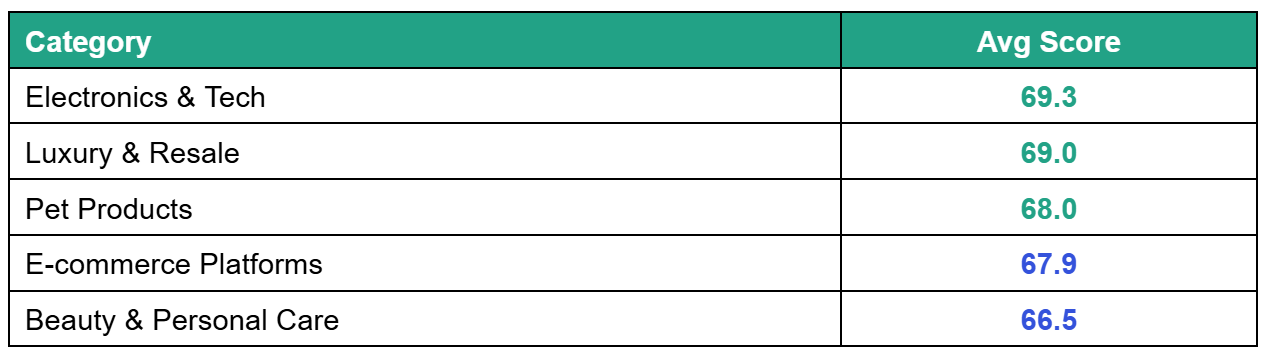
Top Performing Verticals
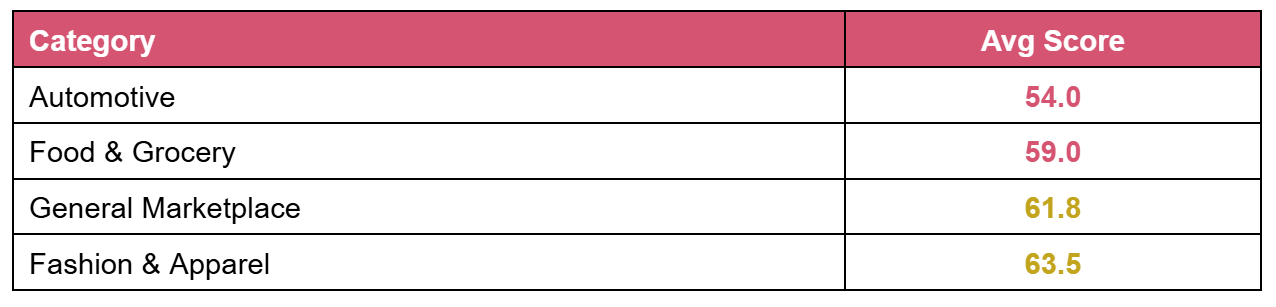
Underperforming Verticals
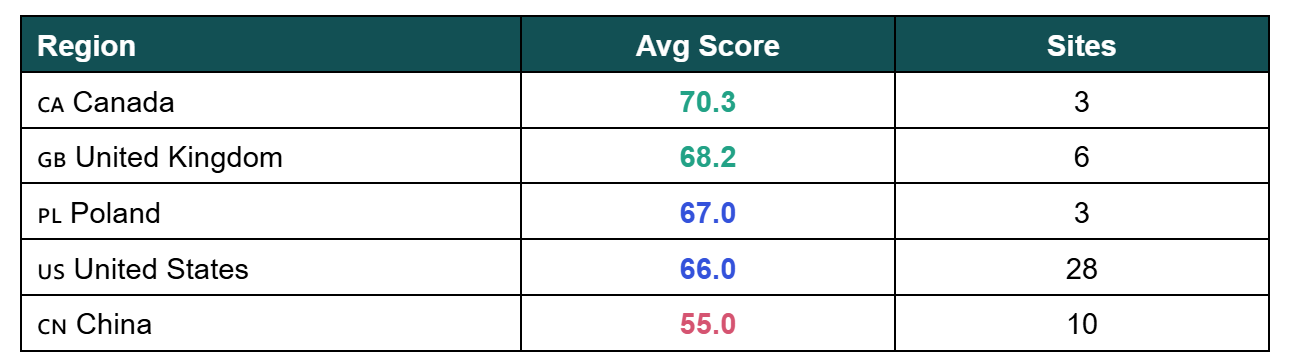
Regional Analysis
Technology Stack Impact
The JavaScript framework landscape reveals interesting patterns that directly impact AI visibility:
- React: 36% of sites (26 sites)
- Next.js: 25% of sites (18 sites)
- Vue/Nuxt: 11% of sites (8 sites)
- Other/Unknown: 28% of sites
Rendering Approach Matters
Client-Side Rendering (CSR) dominates at 78% of sites, but creates significant problems for AI crawlers. The average score comparison shows:
- CSR average score: 63.0
- SSR/SSG average score: 67.2
This 4.2-point gap between rendering approaches demonstrates that technical architecture decisions have a meaningful impact on AI visibility. Sites considering framework migrations or redesigns should prioritize server-side rendering for critical product pages.
Access the State of AI Search for E-commerce — Free Infographic
Recommendations
Critical Priority (Week 1-2)
- Fix JavaScript Rendering — Ensure product content is available without JS execution. Implement server-side rendering or pre-rendering for key pages to ensure AI crawlers can access your content.
- Image Alt Text Audit — Conduct a comprehensive audit of product image alt text. Every product image should have descriptive, keyword-rich alternative text that enables AI systems to understand visual content.
- Product Schema Enhancement — Complete structured data with offers, reviews, and availability. Implement comprehensive Product schema including aggregateRating, availability, and brand information.
High Priority (Week 3-4)
- Semantic HTML Structure — Implement proper heading hierarchy and semantic markup. Refactor page templates to use semantic elements that AI systems can parse.
- Update robots.txt — Review and allow appropriate AI bot access. Audit your robots.txt for AI bot directives and ensure legitimate AI systems can access your content.
- FAQ Schema Implementation — Add question-answer markup for common product queries. This is a proven method for improving featured snippet visibility.
Strategic Priority (Month 2-3)
- SSR/SSG Migration — For sites heavily dependent on CSR, evaluate the business case for migrating critical pages to server-side rendering.
- Knowledge Graph Integration — Build entity relationships across your product catalog using structured data relationships.
- Explore llms.txt (Optional) — As a low-effort experiment, consider implementing llms.txt for potential future benefits. However, given the lack of confirmed support from major AI providers, this should not take priority over proven optimization factors.
Conclusion
The State of AI Search for E-Commerce reveals an industry at an inflection point. With an average AI readiness score of just 64/100 and zero sites achieving “Good” ratings across multiple critical metrics, the gap between current practice and AI-ready optimization is substantial.
The good news: the most impactful improvements are well-understood, proven technical optimizations—image accessibility, JavaScript rendering, structured data implementation, and semantic HTML structure. These are established SEO best practices that also benefit AI discoverability.
While emerging standards like llms.txt may eventually play a role in AI optimization, organizations should focus first on the proven factors that demonstrably impact both traditional search and AI systems. The sites that invest in these fundamentals will be best positioned as AI-powered discovery continues to evolve.
Focus on proven factors first. Experiment with emerging standards second.
About This Research
This report was produced by WordLift, a semantic SEO and AI visibility technology company helping brands become discoverable by both humans and AI systems.
Our analysis draws on proprietary AI readiness auditing methodology, examining technical implementation across seven dimensions to produce actionable insights for e-commerce optimization.
Data Coverage:
- 100 e-commerce websites analyzed
- 86 sites with complete scoring data
- 14 industry categories
- 26 countries represented
- Data collection: January 2025
For questions about methodology or to request a custom AI readiness audit for your e-commerce platform, visit wordlift.io.