Cutting AI Compute by 34% Without Losing Control: The Reverse Information Paradox
Every AI system pays for intelligence twice: once in money, once in the knowledge it consumes to work. This benchmark shows what happens when that intelligence moves into a governed knowledge layer instead: 34.2% lower compute, no loss in accuracy.

If you’re the one who has to defend your AI spend next quarter, don’t bring your CEO another chart showing how many prompts your team ran. Bring them a better question: how much valid work are we getting from the compute we’re buying?
You now pay for intelligence twice: once in money, and once in the proprietary knowledge you have to expose to make that intelligence useful. Satya Nadella has described this as the Reverse Information Paradox. Kenneth Arrow’s original paradox was the seller’s problem: to demonstrate the value of information, you have to reveal it. AI reverses the direction. The buyer purchases intelligence, then has to supply product knowledge, terminology, rules, examples, corrections and policies to make that intelligence useful.
At WordLift we process roughly 500,000 pages and close to one million entity operations a day. At that scale, this isn’t philosophy. It’s architecture, governance and unit economics.
The benchmark
We tested whether part of the intelligence can move out of the model and into infrastructure you govern, without sacrificing output quality.
Using AOOE — Agent-Oriented Ontology Engineering — we compared a raw frontier model with a smaller model operating against an explicit knowledge graph, selected evidence, deterministic rules and validation gates. We ran 30 paired trials on Product structured data and another 30 on grounded FAQ generation.
Both architectures reached 60/60 valid outputs. So the question wasn’t which system eventually produced the right answer. It was how much work each system needed to get there.
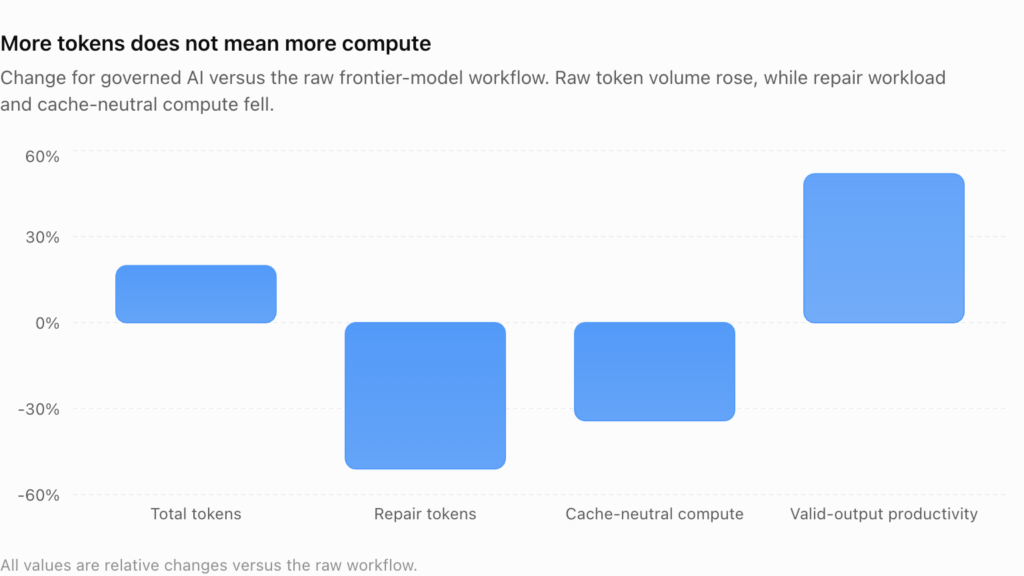
Across the combined benchmark, the governed workflow delivered 11.1% lower billed cost per valid output, 34.2% lower cache-neutral compute, 51% fewer repair tokens and 20 percentage points higher first-pass validity. Valid-output productivity increased by 51.9%.
The raw model got 56.7% of outputs right on the first pass. The governed system got 76.7%. Average repair tokens fell from 1,893 to 928 per valid output.
More tokens, less waste
Here’s the counterintuitive part: the governed system actually used 19.9% more raw tokens overall.
That makes the result more interesting, not less. This isn’t a story about clever prompt compression. The governed workflow sometimes performs more explicit work: retrieving the right attributes, supplying grounded evidence, checking constraints and validating the result.
But raw token count is a poor measure of efficiency. A token contributing to a valid result is not equivalent to a token spent repairing an avoidable mistake.
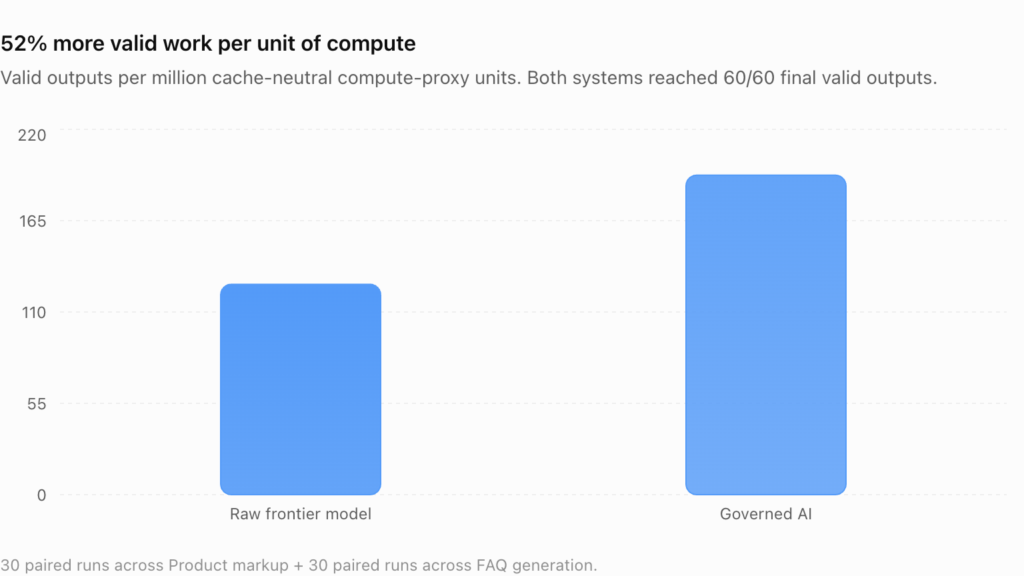
Once we remove the effect of provider caching and compare the workload required to produce a valid result, compute falls by 34.2%. The governed system produced 192.4 valid outputs per million compute-proxy units, versus 126.7 for the raw workflow.
That is a 51.9% productivity improvement.
For someone approving an AI budget, that’s a much more useful KPI than token volume.
Different tasks, different economics
The two use cases also showed why there is no single optimization trick.
For Product markup, the governed workflow used 45.5% more tokens because it followed a multi-step protocol. But first-pass validity improved by 40 percentage points, repair tokens fell 51%, cache-neutral compute fell 27%, and billed cost fell 10.5%. The graph didn’t make the conversation shorter. It made failure cheaper to avoid.
For FAQ generation, the mechanism was different. The system supplied only the approved evidence and constraints needed for the requested intent. That reduced tokens by 56.7%, cache-neutral compute by 66.6%, and billed cost by 15%, while all 30 outputs were valid on the first pass.
In one case governance reduces repair. In the other it reduces context.
That’s why the right enterprise question isn’t, “Which model is cheapest?” It’s: what is the minimum information and inference workload required to produce a valid result?
Sometimes you don’t need a model
A semantic layer shouldn’t only decide which model receives a request. It should also decide whether a model is needed at all.
In our deterministic lower-bound tests, some valid drafts were produced with zero model tokens because the answer could be compiled directly from governed knowledge.
That gives you three paths: deterministic resolution when the knowledge already exists, governed inference when a smaller model can work from constrained evidence, and open-ended inference when a frontier model is genuinely necessary.
Many enterprise systems jump directly to the third option and then try to optimize the token bill afterwards. That’s backwards.
The metric to take to your CFO
If I had to defend an AI investment internally, I would put four numbers on one slide:
| Raw model | Governed AI | |
| Final valid outputs | 60/60 | 60/60 |
| First-pass validity | 56.7% | 76.7% |
| Repair tokens/output | 1,893 | 928 |
| Valid outputs / 1M compute units | 126.7 | 192.4 |
Same valid output. 51% less repair. 34% less normalized compute. 52% more valid work per unit of compute.
That is no longer an AI experimentation metric. It’s an operating metric.
Governance and economics are converging
Every time a generic model needs your taxonomy, product attributes, editorial rules, compliance constraints and examples simply to understand how your company works, more organizational knowledge has to be assembled and pushed into the inference context.
A governed knowledge layer changes that relationship. The durable asset becomes your explicit representation of what things mean, how they relate, which facts are authoritative, which actions are permitted and what counts as a valid result.
Models can change. Pricing can change. Caching policies can change. That knowledge remains inside an architecture you govern.
This is why AI governance and AI economics are increasingly becoming the same conversation.
And the sustainability argument should stay equally disciplined. We don’t have enough provider telemetry to make credible kWh or CO₂ claims. What we can measure is workload: 34.2% less cache-neutral compute and 51% fewer repair tokens per valid output.
The greenest token is still the one you didn’t have to spend fixing an avoidable mistake. Better still: the model call you didn’t need to make.
The takeaway
This benchmark doesn’t show that one model is universally better than another. It shows something more useful: AI cost is a systems property.
Your economics depend on how much knowledge the model has to reconstruct, how often it fails, how much context you send, what can be resolved deterministically and where validation happens.
The result is task-specific, not a universal 34% savings claim. But the mechanism is measurable: make organizational knowledge explicit, constrain inference, validate outputs, and measure compute per valid result.
In the cloud era, enterprises accumulated data. In the AI era, they are accumulating meaning, constraints and operational knowledge.
Don’t optimize AI spending around the price of a token.
Optimize around the cost of a valid result.
Not sure if your AI spend is buying valid results or just more tokens? Let’s find out together.