SEOntology: Giving SEO a Shared Language for the Age of AI Agents
Our research paper on SEOntology just won the Best Student Paper Award at SEMANTiCS 2026. Here's what the peer-reviewed study found, and why it matters for the future of AI-driven SEO.


Winner of the Best Student Paper Award at SEMANTiCS 2026 Developers Workshop, Belgium
We’ve talked before about SEOntology, our open-source framework for giving AI agents a shared vocabulary for SEO. Now it has independent, peer-reviewed validation: our research paper, SEOntology: A Domain Ontology for Semantic Modeling of Search Engine Optimization Workflows, has won the Best Student Paper Award at SEMANTiCS 2026, one of the leading international conferences on semantic technologies.
This isn’t just a nice line for a slide. It’s confirmation, from an academic jury, that the model holds up: it’s logically consistent, it answers the real questions SEO practitioners actually ask, and it works in production, not just in theory. Here’s what the research found, and why it matters.
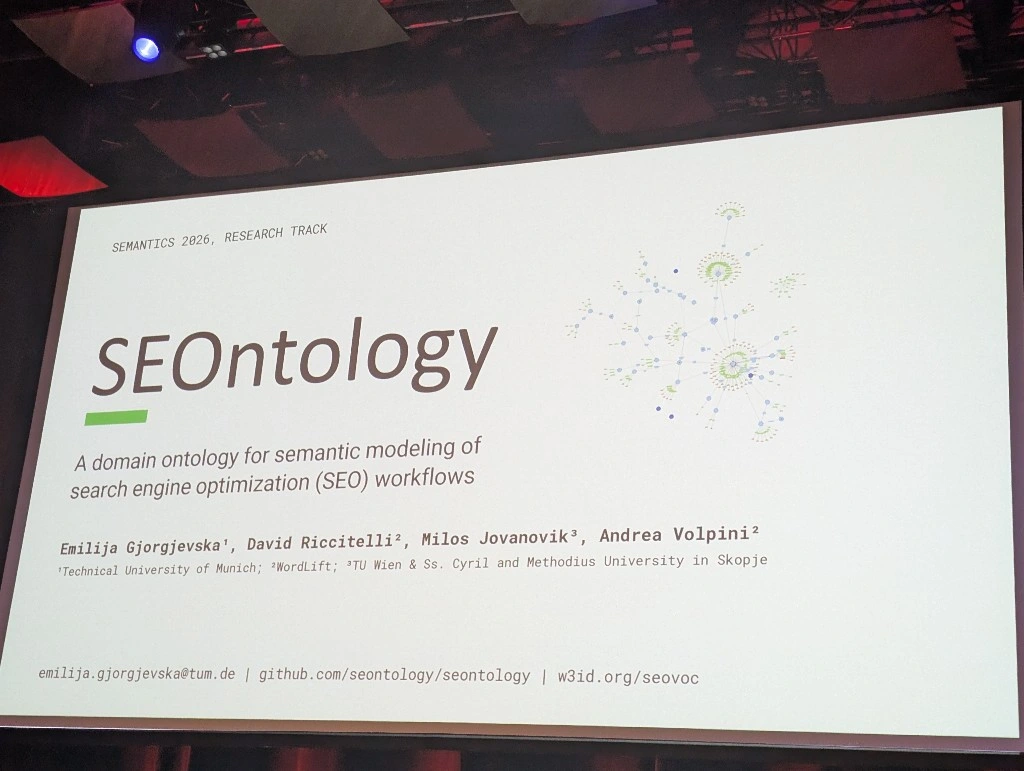
The problem: SEO tools don’t speak the same language
Most SEO tools are excellent at measuring things: rankings, clicks, impressions. What they rarely do is explain why something happened, or connect that signal to everything else happening on your site and across the tools you use to manage it.
That’s because most SEO data lives in loosely structured, tool-specific formats. A ranking report from one platform doesn’t “speak” the same language as an internal-linking report from another. As we explored in Ontologies for the Agentic Web, this fragmentation becomes a real bottleneck the moment you try to let an AI agent reason across your SEO workflow instead of just reporting on it.
SEOntology addresses this by giving all of these concepts, queries, pages, links, quality signals, agent actions, a shared, machine-readable structure, built as an extension of Schema.org, the vocabulary the web already uses to describe pages and content to search engines.
What the paper set out to prove
Academic rigor meant the research team couldn’t just assert that SEOntology works, they had to test it. The paper was built around three questions:
- Can core SEO concepts be formally represented while staying compatible with existing web standards?
- Does the model actually answer the real, recurring questions SEO practitioners have?
- Does it hold up in a live, production environment, not just a lab setting?
To answer them, the researchers gathered requirements from 18 stakeholders, including SEO practitioners, developers, and business teams, and translated their real recurring needs into 47 concrete “competency questions”, the kinds of things a good SEO system should be able to answer. Every question was turned into an executable query and tested against real data.
The results: it works, and it saves real time
The structural evaluation showed the ontology is logically consistent and coherent, with a relationship-rich design (33 classes, 62 object properties, 160 data properties) that reflects how interconnected SEO concepts really are, rather than forcing them into rigid categories.
But the most compelling evidence came from six months of live production deployment, covering 1,233 real SEO tasks on an industrial platform. The results:
- ~30% average reduction in manual effort across all task types
- 95–98% time savings on research-heavy, repeatable tasks like search console anomaly detection, competitive SERP analysis, and structured-data audits
To be precise: these numbers reflect operational efficiency and time saved on recurring work, not a direct claim about ranking improvements. But for anyone managing SEO at scale, cutting hours-long audits down to minutes is a very real, very practical outcome. It’s the same direction we outlined in Future-Proofing Your Content: structure, not just bigger models, is what makes AI-driven SEO work reliably at scale.
Why this matters going forward
SEOntology is built to grow. Its chunk-level content model, which breaks pages into meaningful semantic pieces, is designed to extend toward emerging challenges like Generative Engine Optimization (GEO): understanding how content gets cited, summarized, or surfaced inside AI-generated answers. If you want the fuller picture of how we think about knowledge graphs and SEO more broadly, Build a Smarter Knowledge Graph to Boost SEO is a good next read.
This research already underpins how Agent WordLift reasons about and acts on SEO, and the ontology remains fully open-source, so the wider community can build on it, extend it, and help shape where it goes next.
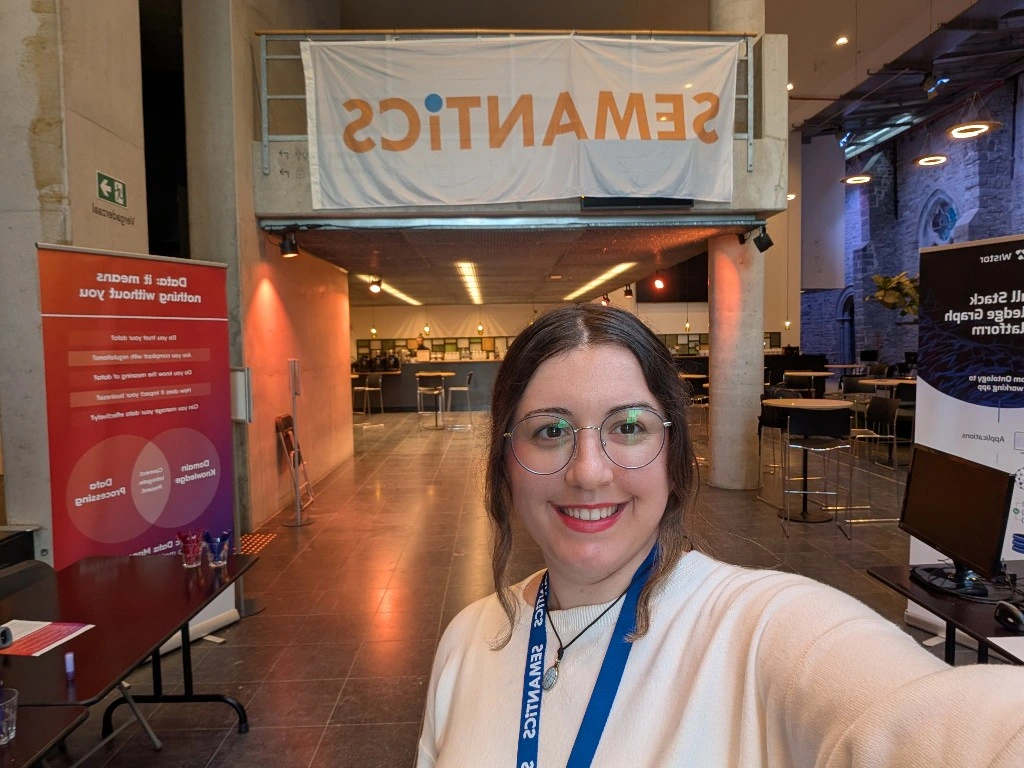
Thank you
This achievement is the result of real teamwork, and we want to recognize everyone who made it possible.
A huge thank you to Emilia Gjorgjevska, who led the engineering and research behind SEOntology with dedication and rigor. To Andrea Volpini and David Riccitelli, who brought their vision and expertise as co-authors and shaped the direction of this work from the start. To Chiara Carrozza, who believed in this project from day one. And a special thanks to Prof. Milos Jovanovik for his guidance throughout the research, and to everyone at the Faculty of Computer Science & Engineering – Skopje, TU Munich and TU Wien for supporting the work behind this paper.
We’re proud to see rigorous academic research turn into something the SEO community can actually use, and even prouder of the team that made it happen.
Want to go deeper?
Want to get involved? SEOntology is open-source.